The End of 'Sorry, I Didn't Understand': How AI Agents Are Replacing Old Chatbots
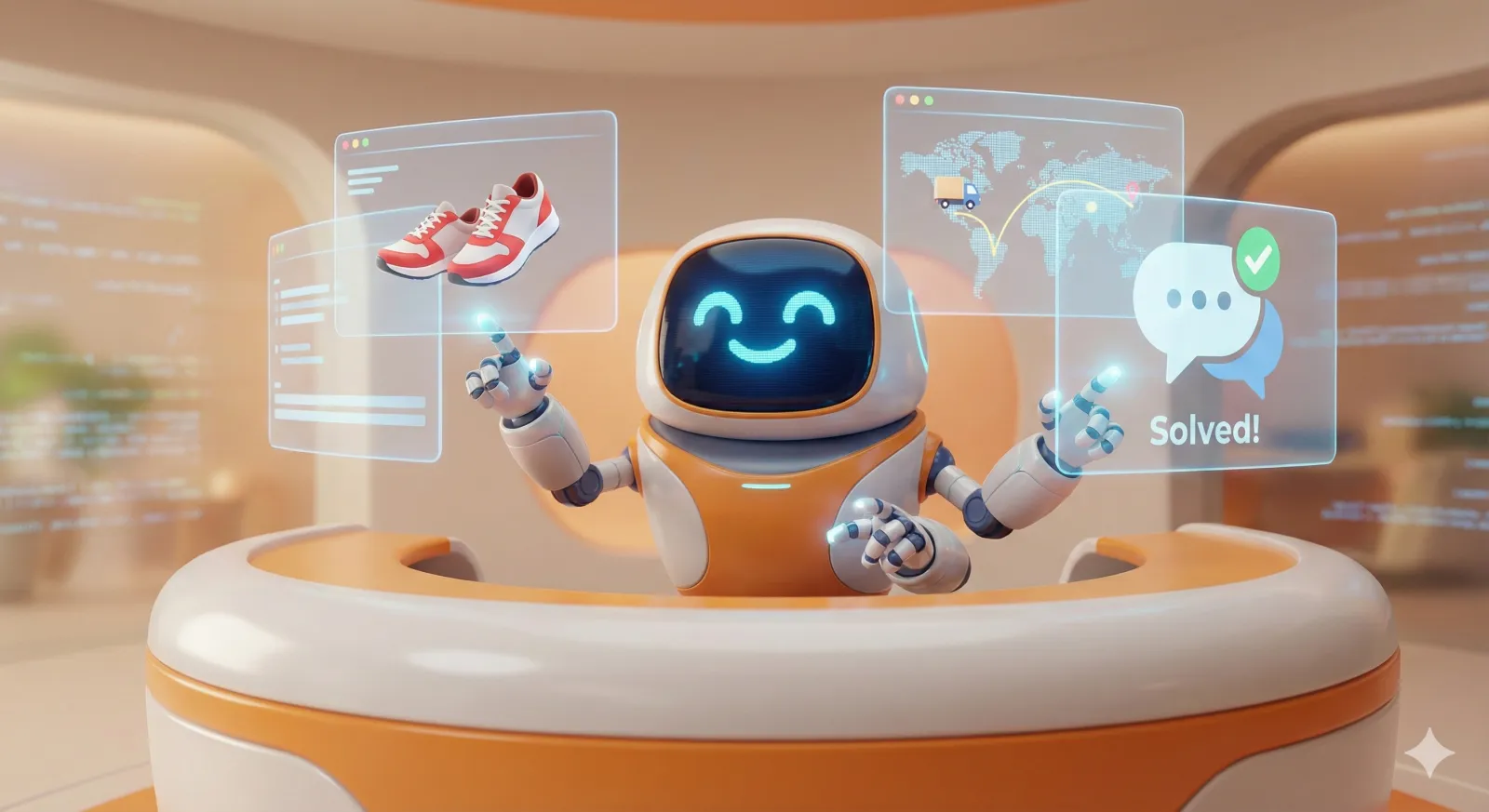
From Simple Scripts to Autonomous Thinkers
If you have been following the tech world recently, you’ve likely heard the term “AI Agent” thrown around in every other conversation. We aren’t just talking about ChatGPT, Gemini etc. those are Large Language Models (LLMs), the engines that process text. We are talking about something bigger: systems that actually do things.
In this article, we are going to look at the “what” and “how” of AI agents. We will assume you know a little bit about programming (pseudocode logic) and have chatted with an LLM before. To make this concrete, we are going to look at the world through the eyes of a classic use case: The Customer Support System.
The Old Way: The Decision Tree
Customer support bots have been around for a long time. Traditionally, they were built using decision trees.
You can think of a decision tree quite literally as a tree with many branches. Each branch represents a specific question or direction the system can take. The user’s journey starts at the trunk and follows a path of “If/Else” statements until they reach a “leaf”, the final answer.
Example: The “Old School” Support Bot
Imagine a simple support bot for an online shoe store. Its code might look something like this:
IF user_input CONTAINS "return":
    Ask: "Do you have your order number?"
    IF user_input is "Yes":
        Ask: "Please type it in."
        [System checks database]
    ELSE:
        Print: "Please find your order number and come back."

ELSE IF user_input CONTAINS "shipping":
    Print: "Shipping takes 3-5 business days."

ELSE:
    Print: "Sorry, I didn't understand. Please say 'return' or 'shipping'."
This works fine if the customer follows the script perfectly. But what happens if the product grows? What if you start selling socks, laces, and gift cards? The tree grows. You add more branches, more IF statements, and more complexity.
The Problem: It Doesn’t Scale
In engineering terms, decision trees don’t scale well. You simply cannot write a rule for every possible question a human might ask.
The Scenario: Imagine a frustrated customer types: “I bought these sneakers for my nephew but they are too tight, and also I think the delivery guy dropped them in a puddle so the box is soaked. Can I get a refund?”
The old system looks for keywords. It sees “refund” (maybe mapped to “return”) but it has no logic for “soaked box” or “too tight.” It likely replies: “Sorry, I didn’t understand. Please say ‘return’ or ‘shipping’.”
The customer leaves frustrated. The bot failed because it couldn’t reason; it could only follow a map.
Enter the AI Agent
Now, imagine an automation that isn’t restricted to a map. Imagine a system that can:
- Understand the customer’s intent (even if they tell a long story about a puddle).
- Decide which tools to use (check order status, read the refund policy, or escalate to a human).
- Act on those decisions (process the refund or send an apology email).
- Remember the context (knowing that “it” refers to the sneakers mentioned three messages ago).
- Learn from previous interactions.
That is an Agent.
Simply put, AI agents are autonomous systems that achieve their goals by perceiving their environment, reasoning about it, and taking actions.
If an LLM (like ChatGPT) is a “brain in a jar” that just thinks, an Agent is that brain given eyes (perception), hands (tools), and a memory.
How Agents Work: The Loop
To build a bot that acts like a human support agent, we design it to follow a loop of four capabilities:
- Perceive: It reads inputs from the environment (the user’s chat message, the database status).
- Reason: It thinks about what to do next based on the input.
- Act: It executes a function using predefined tools (like
lookup_order()orsend_email()). - Remember: It stores the result of that action to inform the next step.
Characteristics of an AI Agent
To truly understand how these differ from the old bots, let’s look at the four key characteristics of an agent, applying them to our Shoe Store Support scenario.
1. Autonomous
An agent operates without constant human guidance. You give it a high-level instruction, and it figures out the details.
- The Request: “Find me a pair of running shoes under $120 that are in stock.”
- The Agent’s Reasoning:
- Call the
search_inventorytool. - Filter results where
category == 'running'. - Filter results where
price < 120. - Check
stock_statusfor each. - Rank by rating and return the best option.
- Result: The agent does all this logic alone, returning a curated recommendation.
2. Goal-Oriented
Agents work toward achieving specified objectives. They don’t just chat; they want to reach a “Success” state.
- The Goal: “Process a return for Order #555.”
- The Execution: The agent understands that “Success” means the return is processed in the database and the user has a shipping label. It will keep taking steps, asking for the condition of the shoes, verifying the purchase date, until that specific goal is met.
3. Reactive
Agents respond to changes in their environment. They can handle errors or new information on the fly.
- The Scenario: The agent tries to use the
check_inventorytool, but the database is down (returns an error). - The Reaction: Instead of crashing or saying “System Error,” the agent reasons: “The database is down. I should apologize to the user and try to search the cached catalog instead, or ask them to check back in 5 minutes.”
- The Scenario: The user forgets to mention their shoe size.
- The Reaction: The agent realizes the task is ambiguous and asks a clarifying question: “I found those shoes, but what size do you need?”
4. Proactive
This is where agents truly shine. They can take initiative based on their reasoning.
- The Scenario: The user asks for a specific limited-edition sneaker.
- The Proactive Action: The agent sees the sneaker is out of stock. Instead of just saying “No,” it notices the user’s budget and style preference. It proactively suggests: “The Limited Editions are sold out, but we have the new ‘Sprint-Pro’ model which uses the same technology and is currently 10% off. Would you like to see those?”
Conclusion
The shift from decision trees to AI agents is a shift from scripted flows to reasoning loops.
By giving Large Language Models access to tools and memory, we aren’t just building chatbots that can talk; we are building assistants that can work. Whether it’s finding the perfect flight, coding a website, or handling a complex customer return involving a puddle, AI agents represent the next evolution in how we interact with software.
They perceive, they reason, and most importantly, they act.
- Tagged
- AI
- LLM
- Agents
- Customer Support
- Automation